Romeo and Juliet
Dive into the passion, conflict, and tragedy of Verona with this comprehensive guide to Shakespeare's Romeo and Juliet. Master the themes of fate and patriarchal control, unpack the brilliant use of dramatic irony, and secure top marks by understanding exactly what examiners reward.
Study Notes
Overview
Romeo and Juliet is far more than a simple love story; it is a profound exploration of fate, societal conflict, and the destructive power of a patriarchal society. For GCSE English Literature, examiners are not looking for a retelling of the plot. Instead, they reward candidates who can perceptively analyse how Shakespeare uses language, form, and structure to shape meaning. You must demonstrate how the lovers' tragedy is inevitable from the very first lines, and how the bitter feud between the Montagues and Capulets corrupts the innocence of youth. A successful response will weave historical context—such as Elizabethan beliefs in astrology and the rigid structures of courtly love—directly into the analysis of Shakespeare's methods.
Plot/Content Overview
- Act 1: The play opens with a violent street brawl between the Montagues and Capulets, establishing the backdrop of conflict. Romeo, initially lovesick over Rosaline, attends a Capulet feast in disguise. There, he meets Juliet, and they fall instantly in love, only to discover they are from rival families.
- Act 2: In the famous balcony scene, Romeo and Juliet declare their love and agree to marry. Friar Laurence secretly marries them, hoping the union will end the families' ancient grudge.
- Act 3: The comedy turns to tragedy. Tybalt (Juliet's cousin) kills Mercutio (Romeo's friend). In a fit of rage, Romeo kills Tybalt and is banished from Verona by the Prince. Meanwhile, Lord Capulet forces Juliet to agree to marry Paris.
- Act 4: Desperate, Juliet seeks help from Friar Laurence, who gives her a potion to make her appear dead for 42 hours, planning for Romeo to rescue her from the family tomb.
- Act 5: The tragic climax. Romeo does not receive the Friar's message explaining the plan. Believing Juliet is truly dead, he buys poison, goes to her tomb, and kills himself. Juliet wakes, finds Romeo dead, and stabs herself with his dagger. The grief-stricken families finally agree to end their feud.
Themes
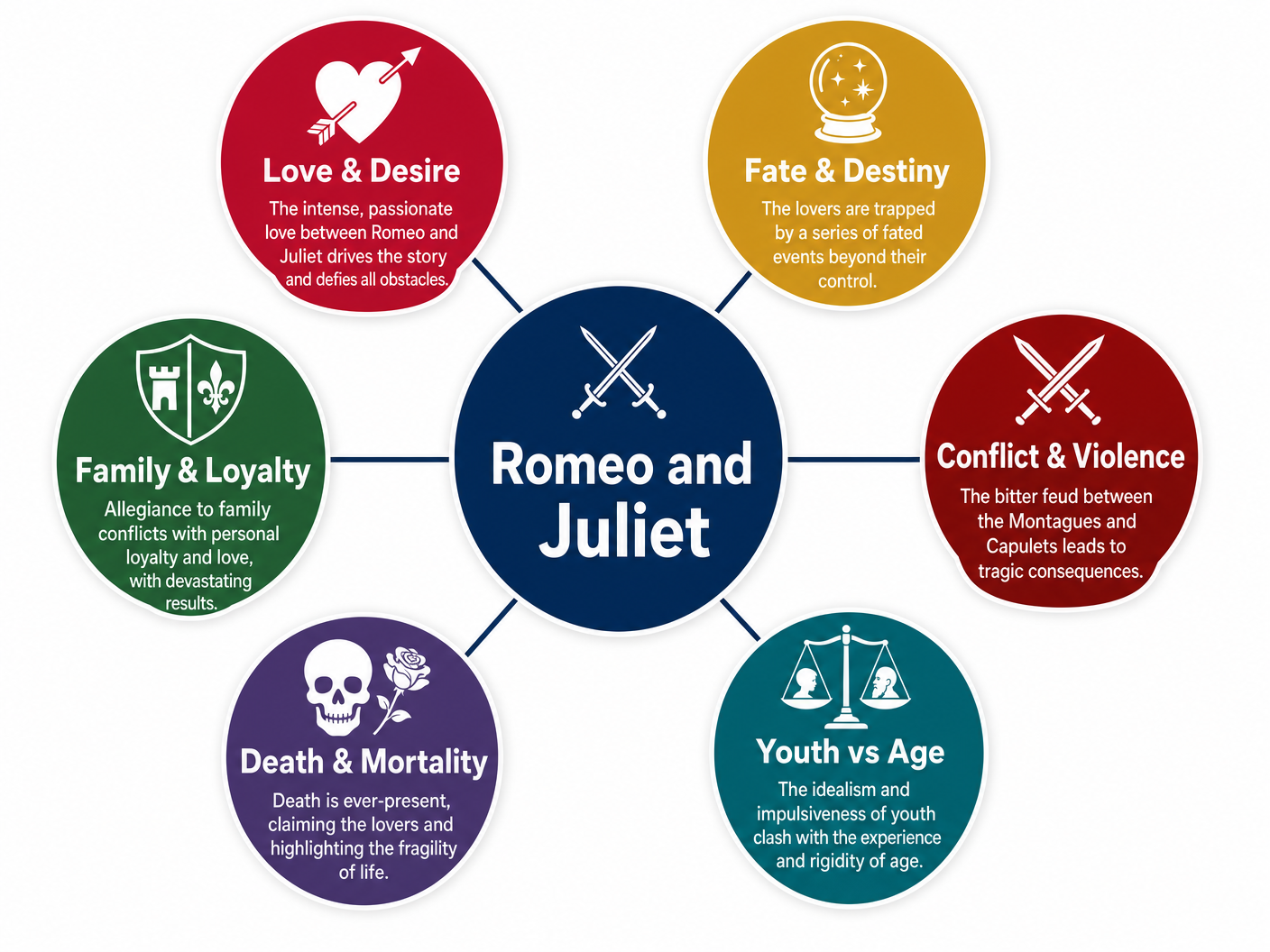
Theme 1: Love and Desire
Shakespeare presents love as an overwhelming, almost violent force that supersedes all other loyalties. The play contrasts the artificial, courtly love Romeo feels for Rosaline with the genuine, transformative passion he shares with Juliet. However, their love is inherently dangerous, constantly described using imagery of light in darkness, which suggests it is brilliant but fleeting.
Key Quotes:
- "O brawling love, O loving hate" (Act 1, Scene 1) - Romeo uses oxymorons to describe his unrequited love for Rosaline, showing his initial immaturity and reliance on Petrarchan conventions.
- "My bounty is as boundless as the sea, / My love as deep" (Act 2, Scene 2) - Juliet's language is natural, expansive, and sincere, contrasting with Romeo's earlier artificial poetry.
Theme 2: Fate and Destiny
The concept of fate hangs heavily over the play. The audience is told the ending in the Prologue, creating a pervasive sense of dramatic irony. The lovers are "star-crossed," a term that would resonate deeply with an Elizabethan audience familiar with astrology. Their tragedy is not just a result of bad choices, but of cosmic inevitability.
Key Quotes:
- "A pair of star-crossed lovers take their life" (Prologue) - The compound adjective "star-crossed" immediately establishes that their destiny is thwarted by the heavens.
- "O, I am fortune's fool!" (Act 3, Scene 1) - Romeo's realization after killing Tybalt that he is merely a plaything of fate.
Theme 3: Conflict and Violence
The feud between the Montagues and Capulets is the catalyst for the tragedy. Shakespeare shows how this hatred infects all levels of society, from the servants to the nobility. The violence is often juxtaposed with scenes of love, highlighting how the older generation's animosity destroys the younger generation.
Key Quotes:
- "Peace? I hate the word, / As I hate hell, all Montagues, and thee." (Act 1, Scene 1) - Tybalt's aggressive triplet solidifies him as the embodiment of the feud.
- "These violent delights have violent ends" (Act 2, Scene 6) - Friar Laurence's warning acts as prophetic foreshadowing, linking intense passion directly to destruction.
Character Analysis
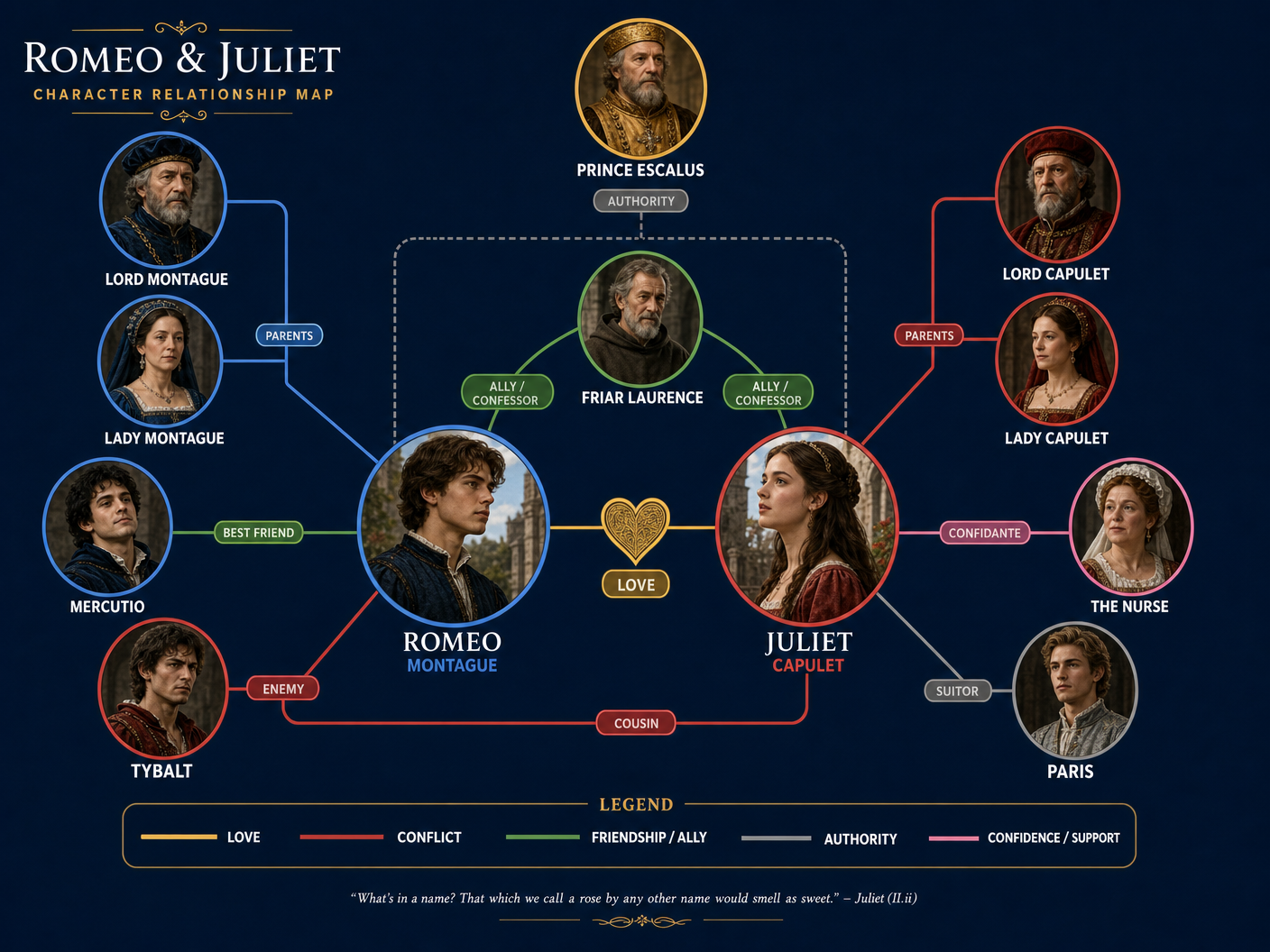
Romeo
Role: The tragic hero, driven by passion and emotion rather than reason.
Key Traits: Impulsive, romantic, fatalistic.
Character Arc: He transforms from a melancholy, artificial lover (infatuated with Rosaline) to a genuinely passionate, albeit reckless, husband who defies society and fate.
Essential Quotes:
- "Did my heart love till now? Forswear it, sight! / For I ne'er saw true beauty till this night."
- "I defy you, stars!"
Juliet
Role: The tragic heroine, whose intelligence and maturity quickly outpace her young age.
Key Traits: Pragmatic, decisive, fiercely loyal, rebellious against patriarchal control.
Character Arc: She begins as an obedient daughter ("I'll look to like, if looking liking move") but rapidly matures into a woman willing to fake her own death to control her destiny.
Essential Quotes:
- "My only love sprung from my only hate!"
- "O happy dagger! / This is thy sheath; there rust, and let me die."
Lord Capulet
Role: The patriarchal antagonist, representing the rigid social structures of Verona.
Key Traits: Controlling, volatile, concerned with status and honour.
Character Arc: He initially appears reasonable, telling Paris to wait to marry Juliet, but becomes tyrannical and abusive when Juliet defies his authority.
Essential Quotes:
- "Hang thee, young baggage, disobedient wretch!"
- "My child is yet a stranger in the world."
Writer's Methods
Shakespeare employs a variety of structural and linguistic methods to shape the tragedy.
- Form: The play is a tragedy, but the first two acts follow the structure of a comedy (masquerades, bawdy humour, secret marriages). The turning point (peripeteia) is the death of Mercutio in Act 3, Scene 1, after which the tone darkens irreversibly.
- Language: Shakespeare uses sonnet forms to elevate the lovers' dialogue. When Romeo and Juliet first meet, their shared dialogue forms a perfect Shakespearean sonnet, symbolising their immediate and perfect connection.
- Imagery: The motif of light and dark is pervasive. Juliet is repeatedly compared to the sun, stars, and torches against the backdrop of night. However, the night is also their only safe haven, reversing the traditional association of light with good and dark with evil.
Context
To achieve high marks for AO3, context must be integrated into your analysis.
- Patriarchy: Elizabethan society was strictly patriarchal. Daughters were considered the property of their fathers, and marriages were arranged for social and financial gain. Juliet's refusal to marry Paris is a radical act of rebellion against this system.
- Astrology and Fate: The Elizabethan audience strongly believed in astrology—the idea that the stars dictated human events. The Prologue's declaration that the lovers are "star-crossed" taps directly into this fatalistic worldview.
- Courtly Love: Romeo's initial infatuation with Rosaline parodies the Petrarchan tradition of courtly love, where a lover suffers agonizingly for an unattainable, idealized woman.
Podcast Revision
Listen to our comprehensive revision podcast to consolidate your knowledge on the go:
Visual Resources
2 diagrams and illustrations
Interactive Diagrams
1 interactive diagram to visualise key concepts
Conceptual Flow Outline
The Structural Shift from Comedy to Tragedy in Romeo and Juliet
Worked Examples
2 detailed examples with solutions and examiner commentary
Practice Questions
Test your understanding — click to reveal model answers
Starting with this extract (Act 1 Scene 5, Romeo and Juliet's first meeting), explore how Shakespeare presents the power of love in the play.
Hint: Look at the shared sonnet in the extract. For the wider play, contrast this genuine love with Romeo's earlier infatuation with Rosaline, and discuss how their love defies the violent feud.
How does Shakespeare present the character of Juliet as a strong female figure? Write about how she changes throughout the play.
Hint: Track her development from an obedient child in Act 1 to a defiant, independent woman taking the potion in Act 4.
Explore how Shakespeare presents the feud between the Montagues and Capulets.
Hint: Consider how the feud affects everyone in Verona, from the servants to the Prince, and how it ultimately destroys the younger generation.
How does Shakespeare use the character of the Nurse in the play?
Hint: Look at her role as a comic foil, a surrogate mother, and ultimately, how her pragmatism betrays Juliet.